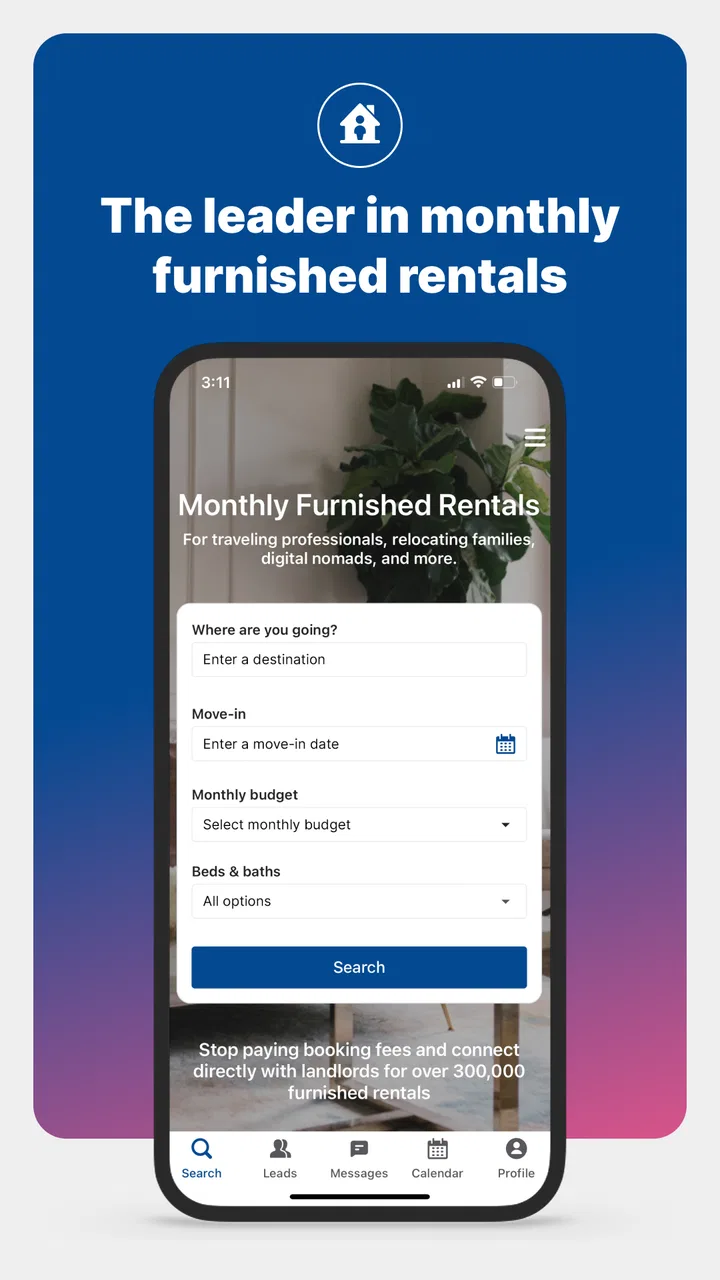
Furnished Finder
- 3.9
- Rating
- 100.00K
- Installs
- Free
- Price

 Analysis by App-foxy
Finding a place for a month is a very different task from booking a hotel for a weekend. I noticed that difference immediately when using Furnished Finder, a free Travel & Local app from Furnished Finder, LLC. Its focus is furnished monthly rentals and housing for people who need to stay somewhere longer, including travel nurses. That narrow purpose gives it a useful identity: it is less about spontaneous tourism and more about making a temporary home workable.
I would recommend it to anyone arranging an extended stay who wants to look beyond hotels and ordinary short-term rental platforms. The app is especially relevant when a job assignment, clinical placement, relocation, or other commitment gives you a clear destination and a rough length of stay. It is not the tool I would reach for when I only need a room for a weekend or want an instant, fully packaged booking.
How Furnished Finder feels during everyday searching
I find the everyday search most useful when I give it a clear boundary before browsing: a work address, a realistic commute, and the length of stay I need. That keeps the task focused on housing I could actually use rather than on attractive but impractical possibilities. It also leads naturally to a closer look at what I can—and cannot—verify while weighing the app and its listings.
You May Also Like

 Blood Strike: 2.5 Anniversary
Blood Strike’s Loadouts Turn Every Drop Into a Tactical Gamble
A close look at Blood Strike’s custom loadouts: how fast access to signature weapons reshapes its battle royale rhythm, rewards preparation, and narrows the gap between fights.

 Pandora - Music & Podcasts
Pandora’s Music Is Easy to Start, but Harder to Recover
Pandora’s strength is its low-effort path from a seed to a station. Its weak spot is how much confidence it asks you to place in connection, setup, and quiet recovery.

 8 Ball Pool
 Is Built on Rivalries, Rematches, and Routine
A close look at the rivalries, rematches, shared routines, and unanswered safety questions that turn a quick pool match into a persistent mobile community.

 Samsung Music
’s Quiet Strength Is Playing What You Already Own
Its reach comes less from spectacle than from dependable access to a personal library. That simplicity is both the app’s strongest retention engine and its ceiling.

 AccuWeather: Weather Radar
AccuWeather Review: A Quick, Clear Forecast for Everyday Decisions
For everyday plans, the best forecast is the one you can understand quickly. AccuWeather makes rain timing, radar, and local conditions easy to act on, with a few trade-offs.

 Hill Climb Racing
Why Hill Climb Racing Still Turns Crashes Into One More Run
A tiny car, a bumpy hill and one more upgrade: Hill Climb Racing keeps resurfacing because its simple chaos makes every near-miss feel personal.
More From Our News Desk



Speed expectations when browsing monthly housing
The app’s basic purpose is easy to understand: search for furnished places suited to monthly living rather than treating every property like a vacation booking. That makes the experience feel more practical than entertainment-oriented. I found myself thinking about commute distance, whether the space could support a normal routine, and how much information I would need before contacting a landlord.
Search speed matters here, but it is not the only kind of speed that counts. A fast list is not especially helpful if each property still requires careful checking. Monthly housing involves details that can change the decision completely, such as the actual location, the furnishing level, the arrangement for contacting the owner, and whether the timing fits the assignment. I therefore judge this app by how quickly it helps me narrow realistic options, not simply by how quickly a screen appears.
On a reasonably modern phone, the app should be approached as a focused browsing tool rather than a full property-management system. The current version is 1.7.0, and its relatively compact role is an advantage: I can use it to discover suitable housing without expecting it to replace every step of the rental process. Once I find a promising listing, the important work becomes comparing terms and asking sensible questions.
One useful habit is to search with a decision already in mind. Instead of scrolling through every furnished rental in a broad area, I would start with the workplace or hospital location, then compare a small group of plausible homes. This reduces visual clutter and helps the app feel faster because I am not asking it to solve an undefined problem.
What happens during heavier use
The busiest moment is not necessarily the first search. It is the point where I am comparing several places while checking dates, locations, and living arrangements. A person relocating for work may return to the same area repeatedly, open multiple listings, and switch between options before deciding which owners to contact. That workflow can feel more demanding than a simple hotel search because the decision is more personal and the stay is longer.
I found that the best way to use the app during this stage is to keep a short written shortlist outside the app. I would note the property location, the reason it fits, the questions still unanswered, and the date of the intended stay. This is not glamorous, but it prevents the common mistake of reopening the same listings without remembering why one seemed better than another.
There is also a practical trade-off in the no-booking-fee positioning. Avoiding a booking fee can make the initial search more attractive, but it also means I should not assume that discovering a property is the same as completing a standardized reservation. I would treat the app as the starting point for arranging housing and read every rental detail carefully before committing. That distinction is particularly important for someone used to hotel apps where availability, payment, and confirmation often follow one familiar flow.
For a travel nurse beginning a new assignment, a realistic routine would be to search after receiving the work location, shortlist homes near the assignment, contact the most suitable landlords, and use the resulting answers to refine the choice. The app is valuable in that process because it keeps the search centered on furnished monthly housing. It does not remove the need for personal judgment, but it can make the first stage more relevant than a general travel marketplace.
Reliability and what I would verify before moving in
The app has been available since February 27, 2019, and it has reached over 100 thousand installs. Its average rating is 3.9 from around 4.1 thousand ratings, with roughly 2 thousand written reviews. Those figures suggest a service people actively use, while also reminding me that the experience is not universally smooth. I would see it as established enough to try, but not as a reason to skip due diligence.
Reliability in monthly housing has two layers. The first is whether the app opens, searches, and lets me move through the discovery process without unnecessary trouble. The second is whether the information and communication around a property remain dependable. The first layer is something an app can support; the second depends heavily on the individual listing and the people involved.
Before treating any listing as suitable, I would ask for the exact address or a precise location, the total monthly amount, what is included, the available move-in and move-out dates, and the arrangements for deposits or other payments. I would also confirm whether the furniture shown is still present and whether the space is private or shared. These questions are not busywork. A monthly stay magnifies small misunderstandings that might be tolerable for a short visit.
I would be particularly careful if my arrival date is close. A search app can help me discover a place, but I would want written confirmation of the agreed terms before traveling. If the rental is for a professional assignment, I would also compare the commute at the actual hours I expect to travel rather than relying only on a broad neighborhood label.
The rating tells me to keep realistic expectations about consistency. Some people will find the app exactly suited to their housing search, while others may encounter friction in communication or in the path from browsing to securing a place. My approach is to use it as a useful channel, not as a substitute for confirming the details that matter most.
Device constraints and resource expectations
Furnished Finder supports devices running Android 7.0 or later, which covers a wide range of older and newer Android phones. That makes it approachable for users who do not upgrade frequently. Still, compatibility is not the same as comfort. A phone with an older processor, limited storage, or a crowded screen may make property browsing less pleasant, especially when I am comparing many options in one sitting.
For lighter use, such as checking a few areas or revisiting a shortlist, I would expect modest demands from an app with this focused role. The more demanding situation is extended browsing: repeatedly loading property information, changing search areas, and switching between several candidates. On an older device, that kind of session may feel slower simply because the phone has less room to handle multiple tasks at once.
I would also avoid judging the app only on a perfect connection. Monthly housing searches often happen while commuting, between shifts, or away from home Wi-Fi. If a page takes longer to load, I would first check whether the connection is weak before assuming the app itself is unstable. A practical workaround is to do the broad search when the connection is strong, then reserve mobile data sessions for reviewing the shortlist and following up.
The app is rated for Everyone, so its presentation is suitable for a broad audience. That does not mean every rental decision is simple, though. The interface may be accessible, while the real-world questions remain adult and consequential: suitability for a long stay, payment arrangements, privacy, and the reliability of the person offering the accommodation. I would not let a straightforward interface encourage a rushed decision.
Recovery when a search session goes wrong
Recovery is important because housing searches are rarely completed in one sitting. If the app closes, the connection drops, or I lose track of a property, I would want a simple way to recreate the search from the location and dates rather than depending entirely on memory. My own safeguard would be to record promising details as I go and save contact information or notes in a separate place when appropriate.
This is also where the app’s focused purpose helps. I can return with a clear objective instead of rebuilding an entire vacation itinerary. If I am searching for housing near a hospital or temporary workplace, the destination itself gives me a stable starting point. I can repeat the search, compare the same general area, and continue contacting suitable options.
At the same time, I would not rely on an interrupted app session as proof that a rental is still available. Availability can change while I am away, so recovery should mean restarting the verification process, not assuming the previous screen represents the current situation. For a move scheduled soon, I would keep a backup shortlist rather than placing all my hopes on one property.
That backup approach is one of the less obvious advantages of treating the app as a housing research tool. A person who saves only one favorite may be forced into a poor decision if the owner does not respond. Keeping several realistic alternatives gives the search resilience and makes it easier to negotiate from a position of patience.
Where it beats ordinary travel alternatives
Compared with a hotel app, Furnished Finder is better aligned with the needs of someone staying for a month or longer. Hotels are convenient for short visits, but their pricing and room setup are not always comfortable for living through a work assignment. A furnished monthly rental can make more sense when I need a kitchen-like routine, a residential setting, and a place that feels less temporary.
Compared with a broad vacation-rental marketplace, this app’s strongest difference is its emphasis. General platforms are useful when I want flexible holiday dates, tourist amenities, or a quick weekend reservation. They can be less efficient when my main question is, “Where can I live near this assignment for an extended period?” A specialized search reduces the number of irrelevant vacation-style results I need to consider.
The trade-off is that a general platform may offer a more familiar end-to-end booking experience. If I want standardized checkout, instant confirmation, and a short stay with minimal conversation, I may prefer that alternative. Furnished Finder makes more sense when I am prepared to evaluate a housing arrangement rather than simply purchase a night-by-night stay.
I would also skip it for a spontaneous city break. The app’s value appears when the length and purpose of the stay justify careful matching. For a traveler who wants to compare attractions, book transport, and reserve a hotel in one place, a broader travel app will be more convenient.
Who will get the most from it
The clearest audience is a travel nurse or another professional working temporarily away from home. The same applies to people handling a relocation, a training period, a contract assignment, or a home renovation. In each case, furnished monthly housing can be more practical than repeatedly extending hotel nights.
It may also suit someone who wants to search by living situation rather than by tourism. I appreciate that distinction because it changes the questions I ask. Instead of focusing on a view or a resort feature, I am thinking about distance to work, the ability to settle into a routine, and whether the arrangement fits the full period I need.
Families and couples should still inspect each listing carefully rather than assuming that “furnished” means equally suitable for everyone. A solo professional may accept a compact space or shared arrangement that would not work for a family. The app can help surface possibilities, but the final match depends on the details of the household and the assignment.
People who dislike direct communication with landlords may find the process less comfortable than using a conventional booking service. I would not call that a flaw for every user; monthly housing often benefits from conversation. But if your priority is paying immediately and receiving an automated confirmation with no follow-up, another category of app will probably fit better.
My practical workflow for a safer, faster search
I would begin by defining the non-negotiables: the work location, approximate stay length, maximum monthly budget, preferred privacy level, and acceptable commute. Then I would use the app to find a manageable set of listings instead of opening everything available. This keeps the search focused and reduces the chance that an attractive photo distracts me from the actual requirements.
Next, I would separate confirmed details from assumptions. A furnished room is not automatically a private apartment, and a convenient neighborhood is not automatically a convenient commute. I would write down what the listing clearly establishes and what I still need to ask. That simple separation is especially valuable when several properties begin to look similar.
After contacting owners, I would compare the answers in one place. I would look for consistency between the listing and the conversation, clarity about the total cost, and a willingness to answer ordinary questions. If the response is vague on a detail that affects my decision, I would keep another option active rather than forcing the first one to work.
Finally, I would confirm the arrangement before traveling and retain the agreed information. The app helps with discovery, but a successful monthly stay depends on the transition from search to real-world preparation. That is where patience pays off: a few extra checks can prevent a stressful arrival.
My performance verdict after using it
Furnished Finder is a specialized, free Travel & Local app that makes the most sense when “travel” really means temporarily living somewhere. I like its clear focus on furnished monthly rentals and travel nurse housing, and I find the no-booking-fee approach appealing at the search stage. It gives users a more relevant starting point than a hotel-first app when the stay is measured in weeks or months.
Its performance should be judged by usefulness rather than flashy speed. The app can help me reach relevant housing options quickly, but the meaningful part of the process is comparing details, contacting the right people, and confirming the arrangement. Heavy browsing is manageable when I use a shortlist and keep notes, while older phones and weak connections may make long sessions less comfortable.
The 3.9 average from around 4.1 thousand ratings feels consistent with a service that is useful but not frictionless for everyone. I would install it on an Android device running 7.0 or later if I needed furnished monthly housing, especially for a temporary work assignment. I would not use it as my only option for a last-minute hotel stay or a fully automated booking experience.
My final recommendation is straightforward: use it as a focused housing-search companion, then verify every important rental detail before committing. For the right situation, that focus is its greatest strength. For short vacations or users who want instant, standardized reservations, a conventional travel marketplace will likely feel faster and simpler.
FAQs for Furnished Finder
01What is Furnished Finder and who is it for?
Furnished Finder is a platform designed for traveling professionals seeking short to mid-term housing options. It's particularly popular among travel nurses, corporate travelers, and remote workers who require fully furnished accommodations. The app connects users with property owners offering flexible rental terms, providing a convenient solution for those needing temporary housing.
02How does Furnished Finder differ from other rental platforms?
Unlike traditional rental platforms, Furnished Finder specializes in furnished, short-term rentals. It doesn’t charge booking fees or markups, which can make it more cost-effective. The focus is on connecting travelers directly with property owners, making it easier to find accommodations that meet specific needs, such as proximity to hospitals or work sites.
03Is Furnished Finder free to use for travelers?
Yes, the Furnished Finder app is free for travelers to use. Users can browse listings, contact property owners, and arrange their accommodations without any cost. However, property owners pay a fee to list their properties, which helps maintain the platform and ensure a wide range of available rentals.
04What safety measures does Furnished Finder have in place?
Furnished Finder prioritizes safety by conducting background checks on property owners. The platform also provides a secure messaging system for initial communication, reducing the risk of scams. Additionally, reviews and ratings from previous tenants help users make informed decisions about their accommodations.
05Can I book directly through the Furnished Finder app?
While you can't book directly through the app, Furnished Finder facilitates the connection between travelers and property owners. Once contact is made, the specifics of booking, such as terms and payment, are handled directly between the parties. This approach allows for more personalized negotiation and flexibility in rental agreements.
Pros
- Comprehensive filter options for easier searches.
- Direct communication with property owners.
- No booking fees make it cost-effective.
- User-friendly interface facilitates navigation.
- High-quality property images enhance experience.
Cons
- Limited international listings available.
- Occasional app crashes reported by users.
- Some listings lack detailed descriptions.
- Slow customer support response times.
- Requires account to view full property details.

Furnished Finder
Gallery